From Dessert Trails to Global Streets
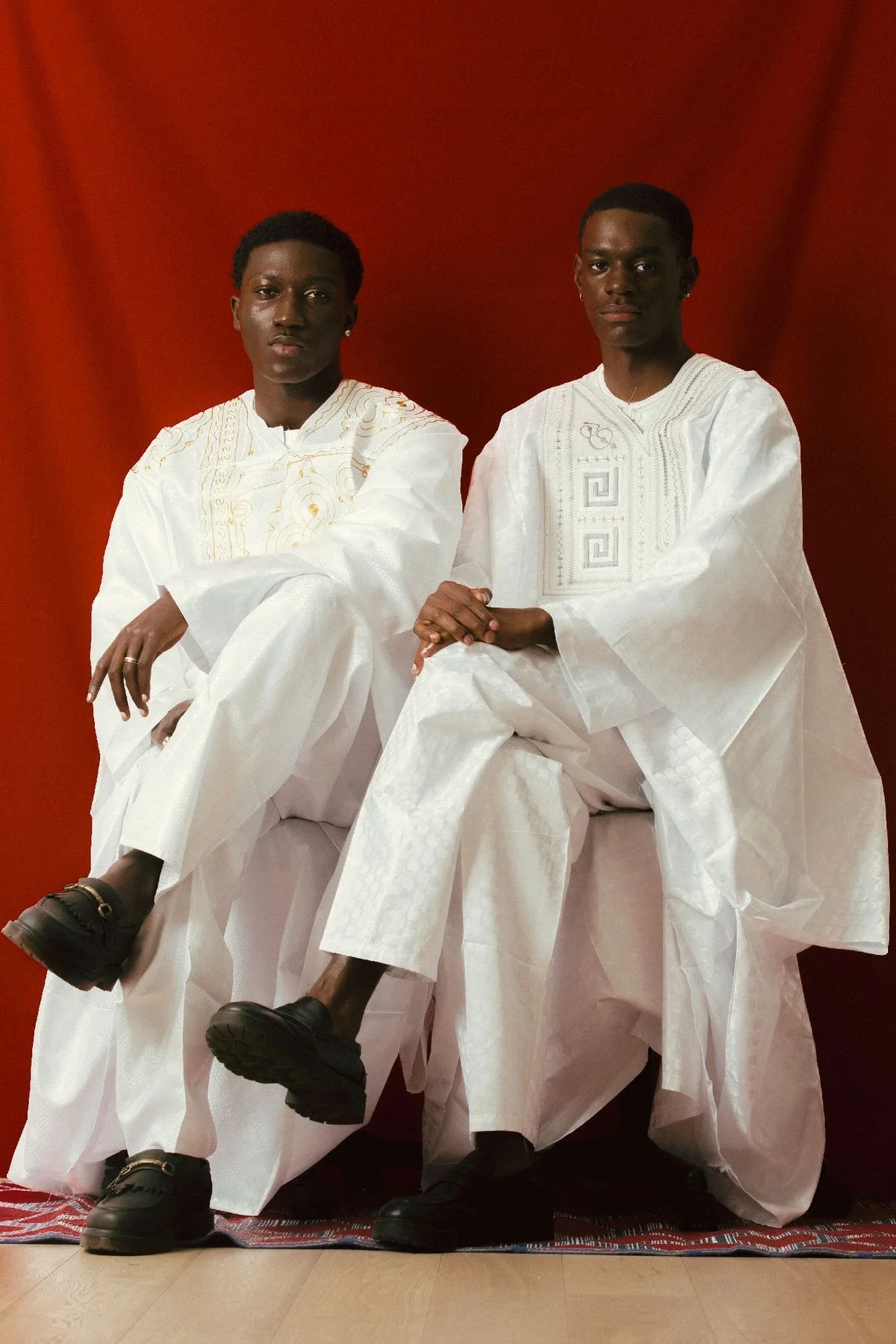
Men in Boubou photographed by Anissa Hidouk
The first time you see a Boubou, it’s impossible to forget. But the attention that the Boubou calls does not fade over time. Constantly, it remains a fashion piece that continues to command space. With flowing yards of fabric and embroidery, the form it takes on the body is effortless and fitting to its wearer.
There are many stunning fashion pieces available today, and it’s easy to get drawn to them without considering their history or significance. However, as Africans, we recognize that everything in our fashion bubble has its own history. The Boubou is not exempt from that list.
The story of the Boubou, also known as Bubu, dates back centuries to the Sahel and West Africa. Specifically, it can be first traced to the 8th century. Its style belongs to the clothing style of the Hausa, Kanuri, Tuareg, Tounou, and other trans-Saharan and Sahelian trading groups.
Its robes were made that way to provide a practical means of protection against the weather encountered while traveling through the Sahara Desert. It was to keep the traders’ bodies protected from the harsh sun during the day and the cold at night. It was also typically paired with a large turban that covered the face, revealing only the eyes.
This Boubou became famous due to its large, fabric-covered design. Islamic scholars and rulers wore it as a sign of modesty and prestige. One ruler went as far as to make it his ceremonial dress. This was Sundjata Keita, the founder of the Malian empire. The Keita dynasty has had a strong bond with Islam since its inception. So Sundjata used this garment to create a strong distinction between himself and all those who had preceded him.
The widespread use of the Boubou as a symbol of West Africa can be attributed to Mansa Musa, a descendant of Sundjata. On his famous pilgrimage to Mecca in 1324 CE, Musa and his entourage were adorned in richly embroidered boubous. Chroniclers recorded not only the gold he gave away but also the splendor of his dress. This cemented the boubou's place in history as a marker of power and prestige.
Every great local empire, especially those linked to Islam, then adopted the Boubou as one of their ceremonial dress. This includes the Fulani, the Hausas, or the Songhai. To wear the Boubou is to clothe oneself in dignity.
What makes the Boubou distinctive is its scale. It’s usually made from a single piece of fabric and is typically 59 inches (150cm) wide, with varying lengths. It is most grand when it reaches the ankles.
The spread of the Boubou, despite its West African roots, has led to its evolution in terms of fabrics, embroidery styles, and even the name by which it's known in each region. Yet the essence remains the same: “a large garment that commands attention and signifies prestige.”
Post-independence leaders like Léopold Sédar Senghor of Senegal, Kwame Nkrumah of Ghana, and Olusegun Obasanjo of Nigeria wore the Boubou to show their roots in West African traditions. To the world, this sent a message that Africa was represented by its own leadership, true to the soil.
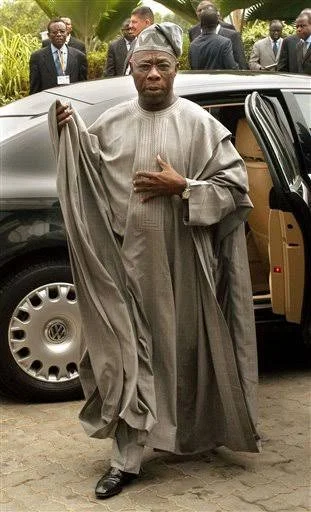
Former President of Nigeria, Olusegun Obasanjo in Boubou
Image source: ChannelsTV
Today, the Boubou continues to evolve to fit whatever scene it’s placed in. In cities like Dakar and Lagos, designers reinterpret it with bold colors, lighter fabrics, or modern tailoring, making it accessible to the younger generation. At weddings, families arrive in coordinated boubou to show they are united and display elegance. At various ceremonies like graduation, the boubou remains the go-to outfit of the day. In Paris, New York, and London, various Africans wear the boubou during festivals or special events. To wear the boubou today is to take part in an ongoing story where clothing is not just fashion but history wrapped around the body.