Why African Fashion Should Move Beyond Prints
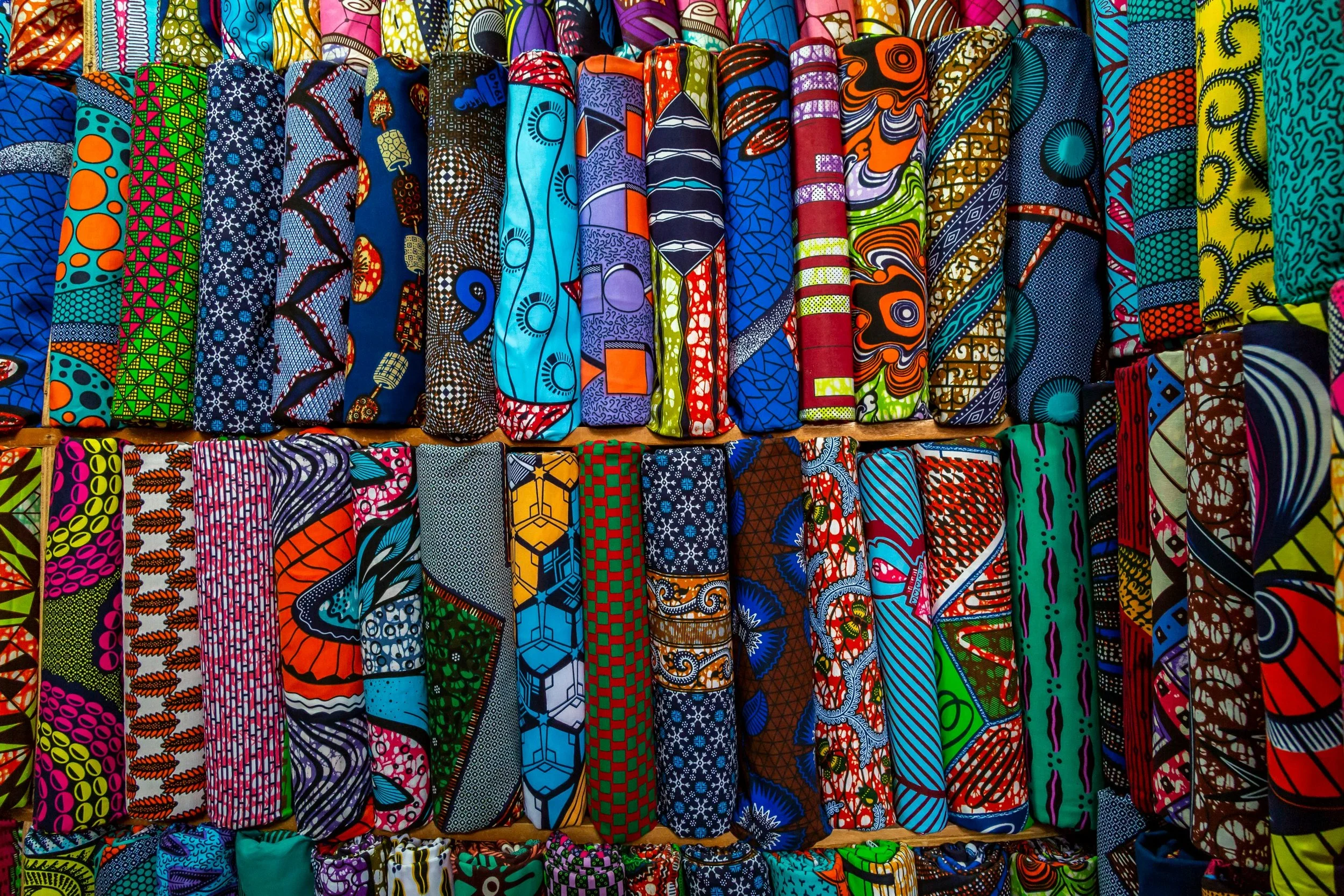
Printed fabrics photographed by Eva Blue
In November 2017, the Nairobi-based arts collective Nest released a book titled “Not African Enough”. This book featured various designers challenging the print narrative that has been bestowed upon Africa.
The book explores the struggles of designers stuck in a vicious cycle, as many want to express themselves beyond the traditional bright, patterned prints associated with Africa. However, when they don’t use these prints, many forget that their designs are still African.
On one hand, prints have served as a cultural anchor. It’s a recognizable visual shorthand that Africans have claimed. But on the other hand, the same anchor has become a box. A box that, when designers try to leave, they get told that their designs are not African enough.
The irony is that what we now call “African prints” are not necessarily African.
You see, these prints were introduced to Africa during the time of trading between Europe, America, and the Far East. It was 1846, and Dutch entrepreneur Pieter Fentener Van Vlissingen discovered a huge demand for printed cotton. He mechanized the methods for printing on batik, a popular cloth worn in Indonesia. However, Indonesia was not a great market for his work. So his company, Vlisco, introduced the final work to the Gold Coast (Ghana), where it blew up and immediately spread across Africa.
In South Africa, shweshwe, an indigo-dyed printed cloth, was imported from Europe. When the Modesty Law was passed, many South Africans had to adopt this fabric. It became so popular in South Africa that the UK clothing brand Tootal invested in Da Gama Textiles, a South African textile company.
Also in Zambia, there is the Chitenge or Vitenge, which is known as Kitenge in East Africa and Congo. It’s a textile printed with a roller on one side. During the 1930s, Kitenge originated in Japan and was introduced to Zambia via the Congo.
So these fabrics came to Africa, were appropriated, Africanized, and woven into culture over time. They became anchors of identity.
So, is clinging to prints really a great cultural anchor?
Personally, I believe it is not. Sure, prints have, over time, become our culture. However, sticking to it is like continuing the narrative that this is what Africa is supposed to be. It’s as though we’ve been handed a box marked “African” and to stick out of it is to be inauthentic.
While the book referenced was written in 2017, we’re still shackled by print and bold colors today. It’s supposedly not African if it doesn’t scream out African at you.
But then this question lingers: “What truly makes a piece African?”
Is it the material?
Is it the designer?
A garment becomes African not simply because of the fabric nor because of the designer’s passport. It is African because the context (history, culture, lived experiences) that informs its creation is African.
Africaness in fashion should not be tied to a single aesthetic or print. It lies in the perspective, intention, and cultural dialogue behind the work.
To limit the lens through which African fashion is seen to just prints is to limit ourselves creatively. The true richness of African style is in its range, so why limit ourselves to these prints and bold colors alone?