The Disconnect Between Nigerian Fashion and Nigerian Weather
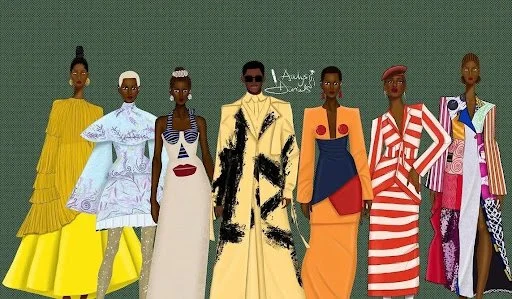
Nigerian brands on the Lagos Fashion Week 2025 runway illustrated by Alice “Uyai” Daniels
Lagos is hot. Delta is hot. Ibadan is hot. Ogun is hot. Ilorin is hot. So I’m not far-fetched when I say Nigeria is hot.
Not sometimes and not seasonally. Just consistently hot in a way that bites your skin and doesn’t leave. Before noon, the sun is already doing too much. By 3 pm, you’re thinking about how to get home without your clothes sticking to your body.
And yet, a lot of the clothes being made don’t seem to acknowledge this.
Nigerian designers are using heavy satins, thick polyesters, and heavy lace. They’re making outfits that retain heat rather than letting it pass through. Clothes you can only really wear if you’re going from car to indoors, indoors to car.
Now I know that there are designers who are exceptions. But this is so common that it makes you wonder who these clothes are designed for.
Because it cannot be for the person standing at the bus stop. Or the person walking from one street to another. Or even the person inside a space where the generator has decided to fail, because obviously no light.
There is a distance between the clothes and the environment we’re supposed to wear them in. I understand that a lot of these designers cater to more than us, but still, this has to be pointed out.
A lot of Nigerian fashion is driven by how it looks. Surely we bring the drama to fashion, but the weather is hot.
There are outfits that look perfect online and then feel unbearable in real life. The kind that you start adjusting the moment you step outside. You’re pulling at the neckline and trying to get the fabric away from your skin. It’s not been an hour, but you’re already thinking about when you can take your outfit off.
Comfort becomes something you can’t always get and sometimes, something you give up entirely.
Part of this comes from what fashion has come to prioritize. The moment something is seen, because if it’s not seen, how will people notice and buy?
So the question becomes: is it eye-catching? Not: Can someone actually wear this for more than two hours?
There is also the influence of global fashion standards. Fabrics and styles that make sense in colder climates are replicated here without much adjustment.
But Nigeria is not that place. You cannot dress for winter in a city that does not have one.
What’s interesting is that this wasn’t always the case.
Clothing across different parts of Nigeria used to respond more directly to the environment. Wrappers, for example, are not just cultural; they are practical. They’re breathable and adaptable. They’re easy to loosen when the heat becomes too much and easy to retie when you need to step outside.
Even looser traditional garments allowed for movement and air. They worked with the weather, not against it. Now, a lot of contemporary fashion feels like it is working against the body instead.
Most people are moving, commuting, sweating, and living in a country that demands a lot physically.
Clothes should be able to fit into that condition. This is not to say that fashion has to become basic or stripped down. There is still room for creativity, for detail, for expression.
But it raises a simple question: why does comfort feel like an afterthought?
There are designers who are paying attention to this. Working with lighter fabrics and thinking about how a piece feels just as much as how it looks.
But they are not the majority, and until that balance shifts, there will always be that gap. Between what is made and what can actually be worn.
You can see it clearly at events. People arrive looking put together, then slowly start to unravel, shoes come off, jackets get removed, and the fans come out. Someone is always looking for where the air is coming from.
The outfit is beautiful, but the person wearing it is uncomfortable. At some point, our comfort should matter more. Because fashion is not just about being seen. It is also about being able to exist, fully, in what you’re wearing.