Everyone Is a Stylist: The Rise of Instagram Styling in African Fashion
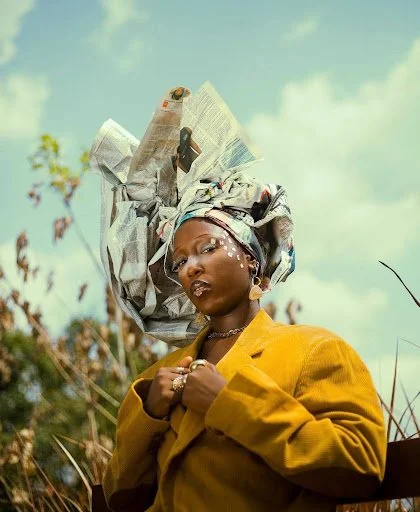
Woman adorned in a newspaper head covering photographed by Adefemi Adedoyin (@colphix_shotit on Instagram)
Who’s a stylist?
Let’s say you put looks together, you shoot them, you post. So over time, you start to build an eye, a following, a point of view.
And before long, people start calling you a stylist.
It makes sense.
Fashion has always been visual, but platforms like Instagram have made it immediate. You don’t have to wait to be published or approved. You don’t need access to a magazine or a runway. You can create your own images, your own concepts, your own language, and put it out there instantly.
Styling, in that way, has become more accessible.
You see it in how people put outfits together now. It’s more intentional. There’s a focus on how pieces interact. How a shirt sits over a skirt, how accessories are stacked, how colors are balanced or deliberately clashed.
It’s not just dressing anymore, but about composition.
Many people have developed this skill by simply doing it repeatedly. They take pictures, look at references, and save looks. They try new things, redo looks in a different way, and post them. So they’re going through a kind of self-training, albeit online and by doing.
But that accessibility changes what the word “stylist” even means.
Traditionally, styling involved working with clients, understanding briefs, pulling pieces, and creating looks for shoots, shows, or public appearances. It required coordination, planning, and a certain level of industry knowledge.
Now, styling can also mean how you present yourself. Your personal page becomes your portfolio. Your outfits become your work. The lines that used to exist between personal style and professional styling have blurred.
And that’s not necessarily a bad thing.
It has opened up space for more people to participate in fashion beyond just wearing clothes. People are experimenting more and taking risks. They’re building distinct aesthetics that might not have existed within more traditional spaces.
It has also made fashion feel closer. You don’t have to imagine what something looks like styled a certain way. You can see ten different interpretations of the same piece just by scrolling. You can watch how trends form, shift, and fade in real time.
But there is also a sameness that comes with it. While everyone is styling, many people are pulling from the same references.
So you start to notice patterns, and at some point, it becomes harder to tell where inspiration ends and imitation begins.
Another thing that gets lost sometimes is the depth of the work. Styling is not just about putting together outfits that look good in pictures. There is research behind it, as well as cultural references. There’s also a need for an understanding of fabric, proportion, and history.
Styling is the ability to translate an idea into something visual in a way that feels cohesive and intentional. It’s not always easy to see that online. What people see is the final image and not the process behind it.
On one hand, it’s good that more people feel like they can engage with fashion in this way. It breaks down barriers. It allows for new voices, new perspectives.
On the other hand, it flattens the work. When everyone is a stylist, the word starts to stretch. It begins to cover too many things at once.
There are people building full creative practices, working on shoots, collaborating with designers, and shaping how collections are presented. And there are people documenting their outfits online.
Both are valid, but they are not the same.
Still, the rise of Instagram styling cannot be undone. It reflects a larger shift in how fashion operates now. There’s less gatekeeping, more visibility, and more participation.
The industry is no longer the only place where styling exists.
It’s in the bedrooms, on the rooftops, in front of mirrors, and on the streets where someone has set up a camera and is trying to get the right shot before the light changes.
And maybe that’s the most interesting part of it. That styling is no longer confined to a specific role or title. It’s something people are claiming for themselves, in real time, with whatever they have.
Whether or not they are called stylists in the traditional sense almost becomes secondary because they’re styling.