Fashion Supply Chains in Africa: Where Are the Missing Factories?
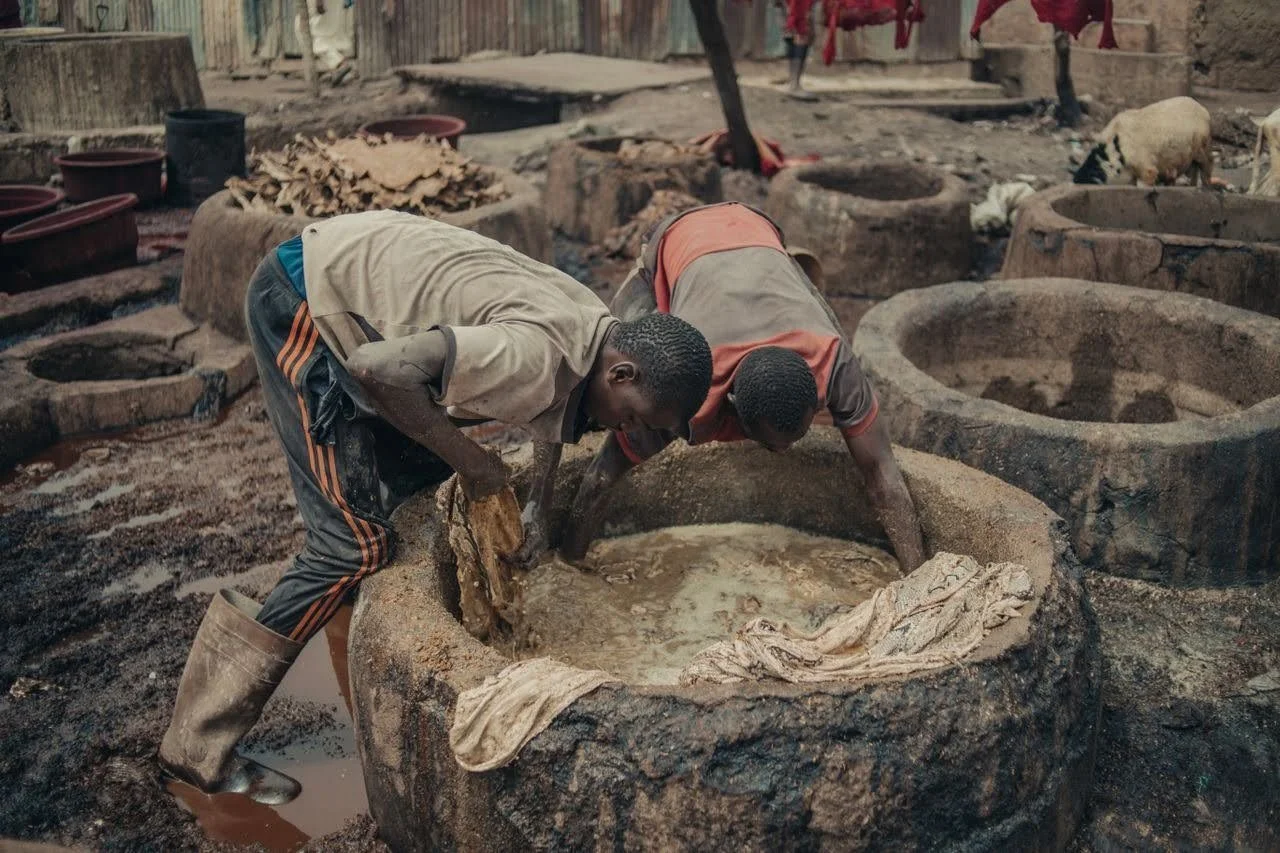
Two men work in a traditional fabric dyeing factory, using natural methods, photographed by Ahmad Bello.
Despite vibrant creativity and global acclaim, many African fashion designers face a persistent struggle: the absence of processing infrastructure to produce their garments at scale. Local ateliers, rather than industrial manufacturers, dominate the scene. This upside-down structure makes it difficult to meet growing global demand.
This article examines the location of the missing factories, their significance, and the primary barriers hindering the industry's progress.
1. The Legacy of Under-Industrialization
Africa’s colonial history established economies primarily rooted in resource extraction, rather than manufacturing. After independence, attempts to build industrial capacity, like textile mills, were undermined by structural adjustment, policy reversals, and a lack of sustained investment. Today, Africa remains the least industrialised continent, with manufacturing contributing just about 1.9% of global output.
2. Crippling Infrastructure
Several systemic issues compromise the fashion supply chain:
Energy Instability: In Nigeria, manufacturers often rely on diesel generators due to frequent power grid outages. This costs the economy an estimated $28 billion annually.
Transportation Bottlenecks: Sub-Saharan Africa’s road density and network have plummeted over the past 20 years. This also includes the railroad network. So the combination of poor roads, congested ports, and inefficient logistics inflates costs and stifles businesses.
These gaps make local textile factories less productive, more expensive, and reliable compared to textile hubs in other nations.
3. Supply Chain Fragmentation
Many designers cannot secure consistent supplies of fabric due to:
Bulk Ordering Issues: For instance, Nigerian designer Oroma Cookey-Gam sources cotton from the Funtua mill in Katsina, which prefers to work with bulk clients over boutique or fashion brands. This forces her to enlist the help of other designers for joint orders.
This is a major problem for startups because they will be unable to work with one of the few mills in the country due to their inability to order in large quantities.
Dependence on Imports: A large quantity of the textiles sold in Africa is imported from Asia, but the raw materials needed for those textiles are exported from the same continent. Burkina Faso and Mali export 90% of their cotton and then import finished fabrics.
Africa loses an estimated $3 billion annually importing Dutch wax instead of producing it locally, undermining industrial autonomy.
Chinese Market Dominance: Chinese textile products have flooded African markets with low-cost cloth, shutting out local manufacturers. In Nigeria alone, approximately 80% of local factories have shut down, resulting in the loss of over 250,000 jobs due to competition from cheap Chinese imports.
4. Internal Policy Missteps and Weak Incentives
Government inconsistency further complicates matters. Fabric bans, tariffs, and incentives swing with political winds, making it difficult for factories to operate sustainably. Supply chain inefficiencies persist due to weak enforcement, fragmented policy approaches, and hostile investment environments.
5. Regional Exceptions
Despite the grim outlook, pockets of industrial hope are emerging:
Benin's “Farm to Fashion” Project: A €550 million investment to process cotton from seed to garment locally, aiming to replicate successful industrialisation models by 2030.
Ethiopia's Manufacturing Hubs: The Ethiopian government has invested in industrial parks, attracting brands like H&M to source locally, thanks to low labour costs and export incentives.
Fashionomics Africa: AfDB-backed digital initiatives help entrepreneurs access markets and manage supply chains across the Ivory Coast, Nigeria, Kenya, Ethiopia, and South Africa.
6. The Human Cost of the Bottlenecks
The absence of robust supply chains forces designers to rely on small ateliers, which prolongs production timelines, limits scalability, and raises per-piece costs. As a result:
Brands struggle to fulfil international orders across the continent and the world at large, and cannot make any significant impact.
Creative work is slowed by logistics, resulting in missed opportunities.
Many designers are priced out of partnerships that place their work in places around the world or suffer identity dilution when forced to chase cheaper fabrics in countries like China and India.
Possible Solutions To The Supply Chain
1. Investments In Existing Factories and Revival of Older Factories
To address the outstanding issues in the African supply chain, attention and funding must be directed towards the existing and nearly extinct textile mills and factories. The current factories can be refurbished with modern, high-quality machinery to enable them to meet higher demand and reduce production costs.
For abandoned mills, steps should be taken to renovate and revive these factories. Over the years, these factories have become a wasteland, but some still possess the potential to be returned to their previous glory.
2. Fresh Importation Laws
Laws should be enacted by governments in different countries to reduce the importation of fabrics from other countries, thereby encouraging local patronage. Laws should also be made to restrict or reduce the exportation of raw materials needed for fabric production.
3. Grants and Loans for SMEs
To encourage local patronage and substitute for the revenue from the importation, grants and loans should be given to small and medium-scale fashion businesses. This gives these businesses the purchasing power to continuously invest in new factories.
This will inadvertently support and foster growth in Africa’s fashion industry.
4. Investment In Infrastructure
To solve the issues surrounding transportation and energy, all roads must be fixed and maintained to enable the smooth transportation of goods and lower transportation costs. Stable energy must also be introduced to reduce manufacturers' reliance on fossil fuels, such as diesel.
Conclusion
So, the answer to the question “Where are the missing factories?” is that they are simply gone, buried by years of neglect and lack of development. What remains is scattered sparsely across the continent, serving as remnants and reminders of what once was.
The absence of proper supply chains in Africa isn't an oversight; it’s a structural hurdle rooted in history, policy, and infrastructure failings. To transform African fashion from artisanal brilliance to industrial force, the continent must build, literally, from the ground up. That means reliable energy, transport upgrading, consistent industrial policy, and new regional production hubs. Only then can Fashion in Africa thrive.