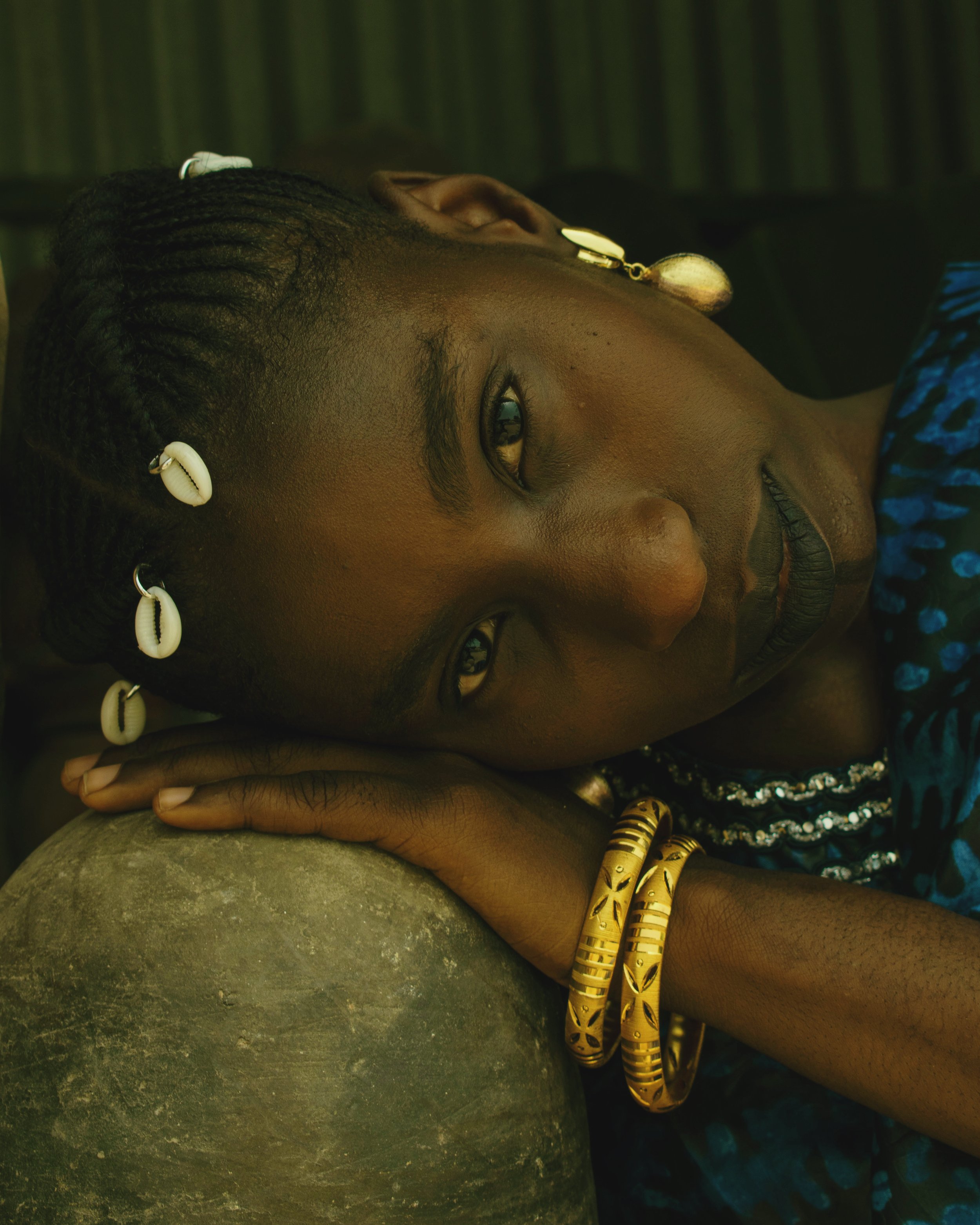
A glimpse of African maximalist fashion photographed by Azeezah Oyeleke.
African fashion has never been subtle. It has always been characterized by bursts of color and bold fabric layers. African fashion is bold yet culturally rich; seams are intricate, and designs are a testament to pure craftsmanship.
Africans did not dress for aesthetics; they dressed for culture. In fact, they dressed to make a statement.
Yet today, a noticeable shift is taking place across African fashion capitals. Designers are increasingly embracing clean lines, neutral palettes, and restrained silhouettes. What is now called “Pan-African minimalism” is steadily replacing the bold visual vocabulary that once defined African fashion worldwide.
The question is not whether minimalism is inherently wrong. The question is: why is it happening, and at what cost?
From Expression to Assimilation
This movement toward minimalism is often justified as evolution or refinement. But beneath that narrative lies a more uncomfortable truth: African fashion is increasingly being shaped to fit Western standards of luxury, taste, and global acceptability.
In global fashion spaces, African designers have long been boxed into expectations. They are celebrated when their work feels “ethnic enough,” yet taken more seriously when it resembles European restraint. Loud prints are admired as costume; clean tailoring is respected as fashion. Over time, many designers have internalized this hierarchy.
Minimalism becomes a way to be taken seriously, to look “global,” to access buyers, runways, and editorial coverage that still operate within Western frameworks of sophistication.
What Gets Lost in the Process
The danger of this shift is not simplicity itself—it is erasure. As designers strip back color, symbolism, and traditional construction methods, entire cultural recipes are quietly disappearing.
African fashion has always relied on process: weaving techniques, dyeing rituals, embroidery styles, and garment structures passed down through generations. These are not easily translated into minimalist aesthetics. When fashion becomes about neutral tones and universal silhouettes, these techniques are often sidelined as too specific, too cultural, or too “local.”
This is evident in the shift from blouses, skirts, or wedding wrappers for guests to corsets. This is not problematic in itself, but it still erases what is intended to be the norm.
In conforming to global norms, African fashion risks losing the very elements that made it distinct.
Minimalism as a Survival Strategy
For many designers, this shift is not purely creative; it is strategic. The global fashion market rewards universality. Buyers want pieces that can sell in Paris, London, and New York without explanation. Clean lines travel better than cultural specificity.
As African brands chase scalability, they often dilute their identity to widen their appeal. This is where minimalism becomes less of an artistic choice and more of a survival tactic.
But survival should not require self-erasure.
The Problem With “Pan-African” Minimalism
Labeling this movement as “Pan-African” is problematic in itself. Africa has never been visually uniform in any single way. To flatten the continent’s aesthetic diversity into beige palettes and structured silhouettes is to ignore centuries of design language.
True Pan-Africanism embraces difference, not uniformity. What we are seeing instead is a narrowing of expression, in which African fashion is slowly being shaped to resemble what the global fashion industry already understands and approves of.
Who Are We Designing For?
This shift raises an important question: are African designers creating for African people, or for Western validation?
When traditional fabrics are replaced with imported textiles, when indigenous silhouettes are abandoned for European tailoring, and when cultural markers are stripped away for “cleaner” designs, the audience subtly changes. Fashion stops speaking to its roots and starts speaking outward.
The danger here is not evolution—it is displacement. African fashion risks becoming unrecognizable to the very communities that inspired it.
Minimalism itself is not the problem. African designers have always experimented, adapted, and innovated. The issue arises when minimalism becomes the default because loudness, color, and tradition are seen as barriers to success.
The most powerful fashion movements do not conform; they redefine standards. African fashion should not have to quiet itself to be heard.
Choosing Preservation Alongside Progress
The future of African fashion does not lie in rejecting modernity, nor in clinging rigidly to the past. It lies in balance. Designers can innovate without abandoning tradition. They can refine without erasing. They can be global without being generic.
If African fashion continues to trade identity for acceptance, it risks becoming another variation of Western design, interesting but replaceable.
And African fashion has never been replaceable.